
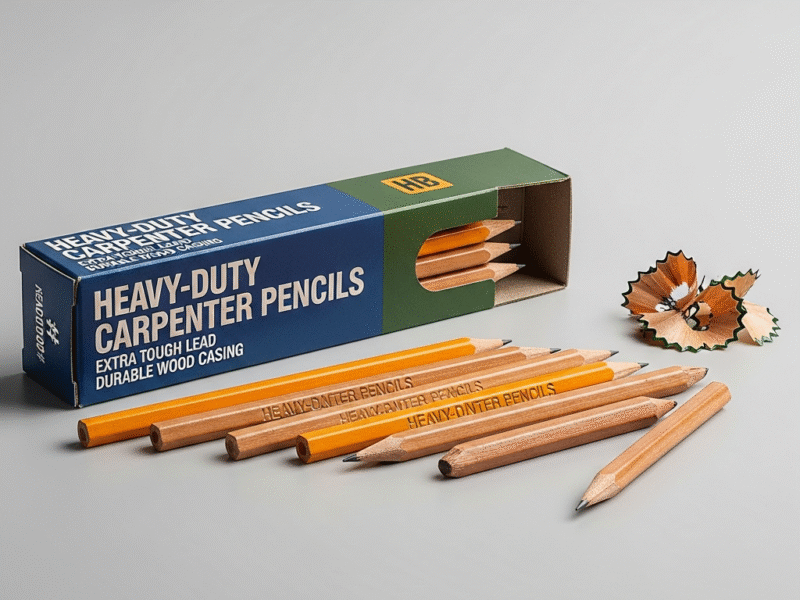
On a chaotic job site, the smallest tool often dictates the pace of the work. You can have the most expensive miter saw and the latest lithium-ion impact driver, but if your mark is invisible or your pencil lead snaps the moment it touches a piece of damp pressure-treated lumber, your workflow grinds to a halt. The search for the right marking tool leads many professionals to move beyond the bulk-bin options and toward high-performance heavy-duty carpenter pencils that can survive the rigors of real-world construction.
The transition from a standard writing implement to a professional-grade marking tool is more than just a change in shape. It is an acknowledgment that the environments we work in—filled with dust, moisture, and abrasive surfaces—require a different caliber of engineering. In this deep dive, we will explore the manufacturing nuances, the shift from wood to mechanical systems, and the specific brands that seasoned contractors trust to get the job done without constant sharpening or internal lead failure.
The Engineering Behind Heavy-Duty Marking Tools
To understand why some pencils cost fifty cents and others cost fifteen dollars, we have to look at the manufacturing process. A standard pencil uses a thin rod of graphite and clay mixture encased in two slats of wood. However, heavy-duty carpenter pencils are designed with a much higher clay-to-graphite ratio. This increases the structural integrity of the lead, making it less likely to shatter when dropped from a ladder or pressed hard against concrete.
In the manufacturing of premium wood-cased pencils, the “bonding” process is critical. High-end brands like Dixon or Bon often use a full-bonding technique where the lead is glued to the wood throughout the entire length of the pencil. This prevents the lead from sliding out and, more importantly, provides a cushion that protects the brittle graphite from impact shocks. When you see a contractor frustratedly sharpening away half a pencil because the lead keeps falling out in small chunks, you are witnessing the failure of a low-quality bonding process.
Furthermore, the wood choice matters. Professional-grade pencils typically use Californian Incense Cedar. This wood is favored in the stationery industry because it is dimensionally stable and has a straight grain that won’t splinter. When you use a utility knife to sharpen a cedar-cased heavy-duty carpenter pencils, the wood peels away in smooth, consistent curls, allowing you to create a precise chisel edge that is essential for fine trim work or cabinet installations.
Mechanical vs. Traditional: The Modern Job Site Debate
One of the most significant shifts in the industry recently has been the rise of the mechanical carpenter pencil. For decades, the flat, rectangular wood pencil was the undisputed king. However, as noted in recent community feedback on mechanical alternatives, many professionals are abandoning wood for the consistency of mechanical systems.
Mechanical versions, such as those produced by Pica or Hultafors, solve the “constant sharpening” dilemma. Traditional pencils require a knife or a specialized sharpener, both of which take time and change the length of the tool. A mechanical heavy-duty carpenter pencils maintains its length, making it easier to pull from a tool belt or pocket. The lead is typically thicker than a standard office mechanical pencil—usually around 2.8mm—providing the strength needed to mark on OSB, stone, or metal without snapping.
Despite the convenience of mechanical options, many old-school contractors still swear by the traditional flat pencil. The rectangular shape is not just to prevent rolling off a roof; it allows for two different marking widths depending on how you hold the tool. For rough framing, a broad mark is easy to see; for precision layouts, the thin edge of the chisel point provides the accuracy required. This versatility is a hallmark of the heavy-duty carpenter pencils category, offering a level of control that round pencils simply cannot match.
The “Internal Breakage” Pain Point
The most common complaint among professionals is internal lead breakage. This occurs when the pencil is dropped or handled roughly during shipping, causing the graphite core to fracture inside the wood casing. You don’t realize it’s broken until you sharpen it, and the tip falls out. This is where the supply chain and manufacturing quality of heavy-duty carpenter pencils come into play.
Top-tier manufacturers implement “pressure-testing” during the extrusion of the graphite cores. By ensuring the lead is dense and devoid of air pockets, they create a product that can withstand the vibrations of a moving service truck or a fall onto a concrete slab. Professional discussions on platforms like contractor insights on tool longevity emphasize that while a pack of cheap pencils might seem like a bargain, the wasted time and material from internal breakage actually make them more expensive in the long run.
For those working in high-moisture environments, the choice of lead also involves “wax-based” additives. Standard graphite can struggle to leave a mark on wet lumber or glazed surfaces. Some heavy-duty carpenter pencils incorporate specialized leads that are water-resistant, ensuring that your layout lines don’t disappear the moment a light rain starts or when the wood “sweats” in high humidity.
Top Brands and Models Reviewed
When evaluating the best options for 2024, several names consistently rise to the top of the list. Each brand brings a different philosophy to the job site, catering to different trades and preferences. A comparative review of professional marking tools highlights that the “best” pencil often depends on whether you are doing rough-in work or fine finishing.
Pica Dry Longlife Automatic Pencil
The Pica Dry has become a cult favorite for a reason. It features a robust “quiver” cap that clips to your pocket, allowing for one-handed use. The built-in sharpener in the cap ensures you always have a fine point. It is the gold standard for heavy-duty carpenter pencils in the mechanical category, capable of marking on almost any surface—from dusty tiles to oily metal.
Hultafors Dry Marker
Similar to the Pica, the Hultafors version is built for durability. It is designed to be ergonomic, reducing hand fatigue during long layout sessions. The lead used in Hultafors pencils is known for being slightly harder, which means it holds its point longer when marking on abrasive surfaces like brick or concrete.
Dixon Ticonderoga Carpenter Pencils
If you prefer the traditional route, Dixon remains a powerhouse. Their carpenter pencils are famous for their bright yellow color (easy to find in a pile of sawdust) and their consistent lead quality. They are the quintessential heavy-duty carpenter pencils for those who want a reliable, no-frills wood pencil that sharpens cleanly every time.
Irwin Tools Carpenter Pencils
Irwin offers a variety of lead hardnesses. This is a crucial feature for specialists. A “hard” lead is perfect for clear, crisp lines on finished wood, while their “soft” lead is better for dark, bold marks on rough-sawn lumber. This level of customization is why Irwin remains a staple in many contractor tool bags.
Comparison of Top Heavy-Duty Carpenter Pencils
| Brand/Model | Type | Lead Diameter/Shape | Key Strength | Best For |
|---|---|---|---|---|
| Pica Dry | Mechanical | 2.8mm Round | Integrated sharpener & quiver cap | All-around versatility, deep holes |
| Dixon Traditional | Wood-Cased | Rectangular/Flat | High-quality cedar, easy sharpening | Rough framing, traditionalists |
| Hultafors Dry Marker | Mechanical | 2.8mm Round | Ergonomic grip, impact resistant | Masonry, tile, and stone work |
| Irwin Medium | Wood-Cased | Rectangular/Flat | Available in multiple hardnesses | Trim work and general carpentry |
| Bon Tool 14-531 | Wood-Cased | Heavy-Duty Flat | Break-resistant core bonding | Heavy construction, concrete work |
Lead Grades and Why They Matter to Professionals
In the world of heavy-duty carpenter pencils, the grade of the lead is just as important as the casing. While a standard #2 pencil is fine for a scantron sheet, it often fails on a job site. Most carpenter pencils are equivalent to an “HB” or “H” grade, but specialized versions exist.
A “Hard” (H or 2H) lead is essential for cabinet makers. It stays sharp longer and leaves a very thin line, which is vital when you are working with tolerances of 1/32 of an inch. However, if you use a hard lead on soft pine or OSB, it may actually “dig” into the wood rather than leaving a mark, or the line may be too light to see in low-light conditions.
Conversely, a “Soft” (B or 2B) lead is the hero of the framing world. It leaves a thick, dark carbon deposit that is visible even from a distance or through a layer of dust. The downside is that it dulls quickly. Understanding this balance is what separates a DIYer from a professional who knows which heavy-duty carpenter pencils to grab for a specific phase of the project.
The Economics of Quality Stationery
It is tempting to look at a 10-pack of generic carpenter pencils for three dollars and think you’re saving money. However, the manufacturing reality suggests otherwise. Low-cost pencils often use “mystery wood” (typically basswood or poplar of inferior grade) and poorly centered leads. If the lead is not perfectly centered in the wood, one side will always be “wood-heavy” when sharpened, making it impossible to get a clean point.
When you invest in high-quality heavy-duty carpenter pencils, you are paying for the precision of the centering and the quality of the graphite. A single Pica Dry lead can outlast three or four traditional wood pencils because you aren’t wasting the material through constant sharpening. Furthermore, the time saved by not having to stop and “fix” your pencil adds up to significant labor savings over a month of work.
For large-scale construction firms, the supply chain for these tools is also evolving. OEM manufacturers are now producing customized marking tools that incorporate specific features requested by trades—such as high-visibility “neon” leads for working in dark crawlspaces or waterproof leads for outdoor landscape architecture.
Maintenance and Care of Marking Tools
Even heavy-duty carpenter pencils require a bit of care to perform at their peak. For wood pencils, the method of sharpening is a point of pride for many carpenters. Using a sharp utility knife allows you to customize the tip—a long, shallow taper for deep marks or a steep, blunt chisel for durability. Avoid using a standard “round” pencil sharpener if possible, as these are often not designed for the harder leads and denser woods used in professional pencils.
For mechanical versions, the primary maintenance is keeping the “clutch” mechanism clean. Sawdust can eventually work its way into the barrel, causing the lead to slip. A quick blast of compressed air every few weeks is usually enough to keep a mechanical heavy-duty carpenter pencils functioning like new. Additionally, always ensure you are using the manufacturer’s recommended lead diameter; even a 0.1mm difference can cause the mechanism to jam or the lead to fall out.
Final Thoughts for the Professional
The humble pencil is perhaps the most underrated tool on any job site. Yet, as we have seen, the difference between a standard implement and heavy-duty carpenter pencils is vast. Whether you prefer the tactile feel of a cedar-cased Dixon or the high-tech efficiency of a Pica mechanical system, the goal remains the same: a clear, accurate mark that stays where you put it.
By understanding the manufacturing processes—from the bonding of the lead to the choice of wood and the density of the graphite—you can make an informed decision that improves your accuracy and reduces your frustration. In an industry where time is money and precision is non-negotiable, your choice of marking tool is a reflection of your commitment to the craft. Don’t let a fifty-cent pencil be the reason your thousand-dollar project is off by an eighth of an inch. Invest in quality
Related Reading
- Benefits of Carpenter Pencils with Flat Sides
- Best Large Size Carpenter Pencils: Reviews and Tips
- Bulk Round Carpenter Pencils for Professional Use
- Bulk Carpenter Pencils Supply for Construction Professionals
- Essential Carpenter Pencils for Construction Teams
- Top Durable Carpenter Pencils for Professionals
- Seahorse® Pencil: Durable Tool for Construction Professionals