
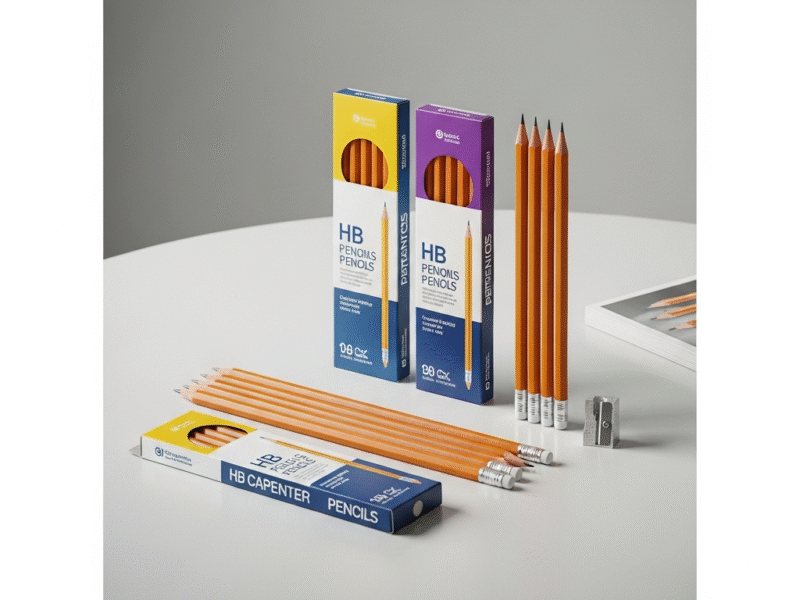
In the world of trades and craftsmanship, the humble pencil remains an indispensable ally. Whether you are framing a house, installing custom cabinetry, or laying out a complex masonry project, the accuracy of your mark dictates the quality of your finished work. For decades, tradespeople relied on a pocketknife to whittle down their marking tools, but the modern workflow demands more precision and efficiency. This shift has led to the widespread adoption of carpenter pencils with pencil sharpener kits, transforming a basic wooden stick into a high-performance marking system.
The traditional carpenter pencil is iconic for its flat, rectangular, or octagonal cross-section. This design was not an accident; it was engineered to prevent the pencil from rolling off sloped roofs or uneven workbenches. However, that same flat geometry makes sharpening a unique challenge. Standard round sharpeners simply do not work. By integrating specialized sharpening tools into the toolkit, manufacturers have addressed the primary frustration of the professional builder: maintaining a consistent, sharp edge without wasting half the pencil in the process.
Understanding the Geometry of the Carpenter’s Mark
To appreciate why carpenter pencils with pencil sharpener are essential, one must first understand the “chisel point.” Unlike the conical point of an office pencil, a carpenter’s pencil is typically sharpened to a flat, broad edge. This allows for two types of marks: a wide, highly visible line for rough framing and a razor-thin line for precision joinery. A specialized sharpener ensures that the wood is shaved away at the perfect angle, exposing the graphite core without compromising the structural integrity of the lead.
When using a knife to sharpen, it is easy to “nick” the lead, creating internal fractures. These fractures cause the lead to snap the moment you apply pressure to a piece of rough-sawn lumber. A dedicated sharpener provides uniform support during the cutting process, which significantly extends the life of the pencil. For those interested in the history of these tools, exploring the evolution of pencil manufacturing reveals how wood species and lead compositions have been optimized for these high-stress environments.
Modern sharpeners often feature a guide that accommodates the rectangular shape, rotating around the pencil or using a linear blade system. This mechanical consistency is what separates a professional layout from a DIY estimate. When your line thickness varies because of a poorly sharpened tip, your measurements can drift by a sixteenth of an inch or more—a margin of error that can ruin expensive hardwoods or critical structural fits.
The Rise of Mechanical Carpenter Pencils
While traditional wood-cased pencils remain popular for their nostalgia and ruggedness, the market has seen a massive surge in mechanical versions. These tools are often sold as carpenter pencils with pencil sharpener built directly into the cap or the body of the tool. These deep-hole markers use thick, 2.8mm or 3.0mm graphite leads that are advanced with a click, much like a standard mechanical pencil but on a much heavier scale.
The primary advantage of the mechanical system is the “deep-hole” capability. The long, narrow stainless steel nose allows the user to mark through drill holes or in tight crevices where a traditional thick pencil cannot reach. Because the lead is consistent in diameter, the integrated sharpener only needs to refine the very tip. This creates a “needle-point” accuracy that is highly valued in electrical work, plumbing, and fine cabinetry.
Manufacturing these mechanical variants requires precision engineering. The internal clutch must hold the lead firmly enough to prevent slipping during heavy marking on concrete or wet lumber, yet release smoothly when the user needs to extend more lead. The sharpener in these kits is usually a small, threaded cap with a tungsten carbide or high-carbon steel blade, ensuring it stays sharp for hundreds of uses.
Material Science in Professional Marking
Not all “leads” are created equal. In the context of carpenter pencils with pencil sharpener, the composition of the marking core is critical. Most professional pencils use a mixture of graphite and clay, but the ratio determines the hardness. A “Hard” pencil (often marked 4H or 5H) is ideal for masonry and stone, as it resists abrasion. A “Soft” pencil (HB or 2B) is better for softwoods and general construction where high visibility is key.
Furthermore, specialty leads are now common in these kits. You will often find “all-surface” leads that include wax or specialized binders. These allow the user to mark on oily metal, glass, plastic, or even wet wood. When you purchase a kit that includes a sharpener, you are often getting a versatile system that can swap between standard graphite and high-visibility yellow or red leads for dark surfaces.
The wood used in traditional versions also matters. Premium carpenter pencils are usually made from Incense Cedar. This wood is preferred by manufacturers because it has a straight grain that does not splinter when sharpened and remains stable under varying humidity levels. Lower-end pencils may use basswood or other softwoods, which are cheaper but often result in a “ragged” sharpen that can frustrate the user in the field.
Manufacturing and Supply Chain Insights
For stationery brands and tool distributors, sourcing carpenter pencils with pencil sharpener involves a deep understanding of OEM (Original Equipment Manufacturing) capabilities. The manufacturing process for a traditional carpenter pencil involves “slatting,” where a block of wood is grooved, leads are placed inside, and a second grooved slat is glued on top—a “sandwich” that is then cut into individual pencils.
The integration of the sharpener into the retail package is a logistics and design consideration. Many top-tier brands now focus on “Value-Added Kits.” Instead of selling a single pencil, they provide a holster, a pack of refills, and the sharpener as a unified marking station. This “holster” concept is a significant ergonomic improvement; it clips to a tool belt or pocket, allowing for one-handed access. The sharpener is often built into the tip of the holster, meaning the pencil is automatically sharpened every time it is holstered or drawn.
| Feature | Traditional Wood-Cased Pencil | Mechanical Deep-Hole Marker |
|---|---|---|
| Shape | Flat/Oval (Non-roll) | Round with pocket clip |
| Sharpening Method | External manual sharpener or knife | Integrated sharpener in the cap |
| Lead Diameter | Wide rectangular core | 2.8mm to 3.0mm round core |
| Best For | Rough framing, heavy construction | Precision joinery, marking through holes |
| Durability | Virtually indestructible | Internal mechanism requires care |
Choosing the Right Tool for the Trade
Selecting the best carpenter pencils with pencil sharpener depends heavily on your specific environment. If you are working in heavy masonry, the traditional wooden pencil is often superior because the wide lead can be shaped into a very robust point that doesn’t snap against stone. The manual sharpeners for these pencils are designed to be “clog-resistant,” allowing the dust from the wood and graphite to fall away easily.
For finish carpenters and cabinet makers, the mechanical kit is the gold standard. The ability to maintain a 0.5mm point via the integrated sharpener allows for “dead-on” accuracy when marking hinge placements or dovetail joints. Many of these professional kits are documented and reviewed in industry publications like Fine Woodworking, where the focus is on the precision of the layout line.
Another factor is the “grip” of the tool. Wood pencils are often finished with a high-friction lacquer to ensure they don’t slip from gloved hands. Mechanical markers often feature knurled metal grips or ergonomic rubberized sleeves. When evaluating a kit, check the quality of the sharpener blade. A high-carbon steel blade will provide a much cleaner cut than a stamped stainless steel blade found in budget-friendly options.
Technical Tips for Optimal Sharpening
Even with the best carpenter pencils with pencil sharpener, there is a technique to achieving the perfect edge. For wood-cased pencils, avoid applying excessive downward force into the sharpener. This can cause the lead to “bind” and snap. Instead, use a light, rotational motion. If you are using a mechanical marker, only extend about 5mm of lead before inserting it into the cap sharpener. This prevents the lead from flexing and breaking during the sharpening process.
Pro tip: When you need the ultimate precision, use the sharpener to create the point, and then lightly “hone” the tip on a piece of scrap wood or a fine-grit sandpaper block. This removes any micro-burrs from the graphite and ensures the line starts exactly where the tip touches the material. This level of detail is what separates a master tradesperson from an amateur.
Maintenance of the sharpener itself is also often overlooked. Graphite is a natural lubricant, but it can also mix with wood resins to create a sticky residue. Periodically cleaning the blade with a small brush or a drop of isopropyl alcohol will keep the cutting edge effective. In mechanical markers, ensure that the sharpener cap is free of graphite dust, as build-up can prevent the lead from seating correctly, leading to off-center sharpening.
The Environmental Impact and Sustainability
In the modern manufacturing landscape, sustainability is no longer optional. When sourcing carpenter pencils with pencil sharpener, look for FSC (Forest Stewardship Council) certification on wood-cased products. This ensures the cedar or basswood is harvested from responsibly managed forests. Since carpenter pencils are consumed quite quickly on large job sites, the cumulative environmental impact of the wood used is significant.
Mechanical carpenter pencils offer a different type of sustainability. While the body is often made of plastic or metal, the tool itself can last for years, reducing the volume of wood waste. The refills come in small, recyclable containers, and the “long-life” nature of the tool means fewer items ending up in landfills. Manufacturers are also experimenting with recycled plastics for the marker bodies and bio-based binders for the leads.
From a cost-benefit analysis, a high-quality mechanical kit might have a higher upfront cost (typically $15 to $25) compared to a pack of bulk wooden pencils ($5 to $10). However, when you factor in the time saved by having an integrated sharpener and the reduced lead waste, the mechanical system often pays for itself within a single project. The efficiency gained by not having to search for a knife or a separate sharpener is a hidden profit margin for the professional contractor.
Advanced Marking Techniques
Using carpenter pencils with pencil sharpener allows for advanced marking techniques such as “scribing.” Scribing is the process of transferring the profile of an irregular surface (like a stone wall) onto a flat board (like a countertop). This requires a pencil that can hold a very fine, consistent point while being held at an angle. A freshly sharpened pencil is the only way to achieve the necessary tight tolerance for a seamless fit.
Another technique is “shadow marking,” where the broad side of the pencil is used to highlight the high spots on a piece of timber that needs to be planed. By having a sharpener on hand, you can quickly transition from this broad-stroke work back to fine-line layout. This versatility is the hallmark of a well-designed tool kit.
In the industrial sector, these pencils are often used for “witness marks” in metal fabrication. A witness mark is a temporary line used to align parts during welding or assembly. Because the leads in modern carpenter kits can be swapped for silver or white versions, they have become a staple in welding shops where traditional graphite is invisible on dark steel. The integrated sharpener ensures that these witness marks remain precise, preventing alignment errors that could lead to structural failure.
Final Thoughts on Marking Excellence
The evolution of carpenter pencils with pencil sharpener reflects the broader trend in the tool industry toward integration and specialized efficiency. No longer is the pencil just a piece of wood; it is a system. By combining material science, ergonomic design, and precision sharpening, manufacturers have provided tradespeople with the tools they need to meet the tightening tolerances of modern construction.
Whether you prefer the tactile feel of a cedar pencil or the high-tech utility of a mechanical marker, the core goal remains the same: a clear, accurate line. Investing in a quality marking kit is one of the simplest ways to improve the quality of your work. As the old saying goes, “Measure twice, cut once,” but we would add, “and mark with a sharp pencil.”
For further reading on the technical standards of professional hand tools, you may consult resources like The National Institute
Related Reading
- Heavy-Duty Carpenter Pencils Review
- Benefits of Carpenter Pencils with Flat Sides
- Best Large Size Carpenter Pencils: Reviews and Tips
- Top Colored Pencils with Sharpener for Artists
- Bulk Round Carpenter Pencils for Professional Use
- Essential Carpenter Pencils for Construction Teams
- Top Durable Carpenter Pencils for Professionals
- Seahorse® Pencil: Durable Tool for Construction Professionals