
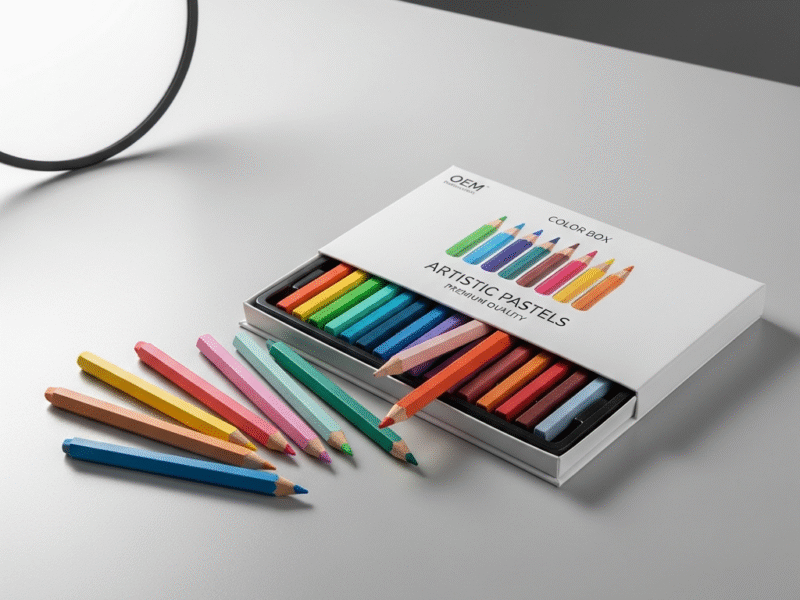
The global art supplies market has witnessed a significant resurgence in tactile, traditional media. Among these, pastel pencils have carved out a unique niche, offering the expressive, painterly qualities of soft pastels with the precision and cleanliness of a traditional pencil. For entrepreneurs and established stationery companies looking to expand their catalog, sourcing the best OEM pastel pencils for art brands is a strategic move that requires a deep understanding of both artist expectations and manufacturing complexities.
Entering the professional art market is not merely about aesthetic packaging; it is about the “laydown.” Professional artists are notoriously discerning regarding lightfastness, pigment concentration, and the structural integrity of the pencil core. When you partner with an Original Equipment Manufacturer (OEM), you are essentially buying their chemical expertise and supply chain reliability to represent your brand’s reputation.
The journey to launching a successful line starts with identifying the specific gap you wish to fill. Are you targeting the student market with affordable, sturdy tools, or are you aiming for the “Precision Meets Luxury” segment occupied by heritage European brands? Understanding these distinctions is the first step in a successful procurement strategy.
The Evolving Demand for Professional Pastel Tools
Pastel pencils have transitioned from being a niche “finishing tool” used for fine details in soft pastel paintings to a standalone medium. This shift has been driven by the rise of hyper-realistic portraiture and wildlife art on social media, where the control offered by a pencil is indispensable. For a brand owner, this means the OEM pastel pencils for art brands you choose must perform under rigorous layering and blending techniques.
Market trends show a growing preference for “open stock” availability and high lightfastness ratings. Artists today are more educated than ever, often researching the ASTM D-4236 standards before making a purchase. They look for pencils that don’t crumble under pressure but still offer that characteristic “buttery” feel that allows for seamless transitions between hues.
By focusing on these professional-grade requirements, a brand can justify a premium price point. The goal is to provide a tool that feels like an extension of the artist’s hand—a balance of wood casing quality, core stability, and pigment vibrance that remains consistent from the first sharpen to the last stub.
Decoding the Anatomy of a Premium Pastel Pencil
To communicate effectively with an OEM manufacturer, you must speak the language of pencil construction. A pastel pencil is fundamentally different from a graphite or colored pencil. The core is composed of a mixture of high-quality pigments, kaolin clay (or other binders like calcium carbonate), and a minimal amount of wax or oil—though many professional pastels are almost entirely oil-free to maintain their matte finish.
The casing is equally vital. Most high-end brands utilize incense cedar because of its straight grain and ease of sharpening. In the context of OEM pastel pencils for art brands, the choice of wood can affect the “sharpenability” of the product. Pastel cores are inherently fragile; if the wood casing is poor quality or the bonding process is flawed, the core will snap repeatedly during sharpening, leading to customer frustration and high return rates.
Furthermore, the diameter of the core matters. A wider core (typically 3.8mm to 4.4mm) allows for broader strokes and more pigment volume, which is a hallmark of professional-grade tools. When negotiating with manufacturers, specifying the pigment-to-binder ratio is the most critical lever you have for controlling quality.
Benchmarking Industry Leaders to Inform Your OEM Strategy
Before developing your own product, it is essential to look at the current market leaders. Research from Potato Art Studios provides a comprehensive breakdown of how brands like Caran d’Ache, Stabilo, and Faber-Castell differentiate themselves. For instance, Caran d’Ache is often cited for its extreme lightfastness and high price point, while Stabilo’s Carbothello line is praised for its versatility and vibrant color range.
As a brand owner, you can use these benchmarks to decide where your OEM pastel pencils for art brands will sit on the spectrum. Do you want the hardness and precision of a Faber-Castell Pitt Pastel, or the soft, almost chalk-like consistency of a Koh-i-Noor Gioconda? Each characteristic appeals to a different artistic style.
Potato Art Studios emphasizes that affordability doesn’t always mean low quality; it often means a different balance of pigment density. By studying these established players, you can identify “white space” in the market—perhaps a professional-grade pencil at a mid-tier price point or a set specifically curated for botanical illustrators or skin tone palettes.
| Feature | Student Grade OEM | Professional Grade OEM |
|---|---|---|
| Core Diameter | 3.0mm – 3.5mm | 3.8mm – 4.5mm |
| Pigment Load | Moderate (Higher Binder) | High (Pure Pigment Focus) |
| Lightfastness | Standard (Varied) | High (Tested/Certified) |
| Wood Casing | Basswood or Pine | Premium Incense Cedar |
| Texture | Waxier/Firmer | Velvety/Crumble-free |
Technical Specifications That Define Product Tiers
When selecting OEM pastel pencils for art brands, the technical specifications are your roadmap to quality control. The first metric to consider is the “tooth” of the pencil. This refers to how the pastel particles grip the paper. A pencil with too much binder will feel scratchy and won’t layer well, while one with too little will be so soft that it disappears into the paper’s grain without leaving a vibrant mark.
Lightfastness is the second non-negotiable metric. Professional artists expect their work to last for decades without fading. High-quality OEMs will provide a lightfastness scale (often using a star system or the Blue Wool Scale) for every color in the range. If a manufacturer cannot provide this data, they are likely producing student-grade materials rather than professional ones.
The third metric is the range of colors. A competitive professional set usually starts at 24 colors but should ideally expand to 72 or even 100+. This variety allows artists to create complex blends without over-working the paper. When sourcing, check if the OEM can maintain color consistency across different batches—a “Sky Blue” from 2023 must perfectly match a “Sky Blue” from 2024.
Navigating the Manufacturing Process: From Pigment to Polish
Understanding how your pencils are made allows you to troubleshoot issues before they reach the consumer. The manufacturing process typically involves wet-mixing pigments and binders, extruding the “leads,” and سپس slow-drying them in a temperature-controlled environment. Fast-drying can lead to internal fractures, which result in the leads breaking inside the wood.
According to insights from Durzerd Pencil, the best brands focus on the synergy between “Precision and Luxury.” This is achieved through meticulous bonding—where the lead is glued to the wood casing along its entire length. This “SV bonding” technique is a hallmark of high-end manufacturing and significantly reduces breakage during shipping and use.
As you evaluate OEM pastel pencils for art brands, ask potential partners about their finishing process. A high-quality lacquer coating on the outside of the pencil not only protects the wood but also provides a premium feel in the hand. Many top-tier brands use water-based eco-varnishes to align with modern environmental standards, which is a strong selling point for eco-conscious artists.
Sustainability and Regulatory Compliance in Pencil Production
In the modern art supply industry, “quality” includes ethics. Any brand looking to source OEM pastel pencils for art brands must ensure their partners adhere to international safety and sustainability standards. The most common certifications include FSC (Forest Stewardship Council) for wood sourcing and PEFC (Programme for the Endorsement of Forest Certification).
From a chemical safety perspective, the pencils must be non-toxic. This is especially important for pastels, as they generate dust that artists can breathe in or get on their skin. Ensure your OEM complies with ASTM D-4236 (Standard Practice for Labeling Art Materials for Chronic Health Hazards) in the US and EN71 in Europe. These certifications are essential for legal distribution and for building trust with your customer base.
Transparency in the supply chain is no longer an option; it’s a requirement. Brands that can claim their pencils are made from sustainably managed forests and use non-toxic pigments have a significant marketing advantage. When interviewing OEMs, ask for their audit reports and certification numbers to verify their claims.
Customization and Branding: Elevating Your Product Line
The “OEM” part of the equation is where your brand’s personality comes to life. While the core of the pencil might be a standard high-quality formula, the exterior is your canvas. Customization options for OEM pastel pencils for art brands range from the color of the barrel to the type of end-cap (dipped or blunted) and the gold or silver foil stamping of your logo.
Packaging is where many art brands win or lose. Pastel pencils are fragile and require protection. A high-quality tin with a foam or plastic insert that prevents the pencils from rattling is standard. However, you can differentiate your brand by offering sustainable cardboard tubes, elegant wooden boxes, or travel-friendly roll-up wraps.
Consider the “unboxing” experience. Artists often keep their pencils in the original packaging for years. A sturdy, beautifully designed tin becomes a permanent fixture in their studio, serving as a constant reminder of your brand. Work closely with your OEM to ensure that the packaging is as durable as the pencils themselves.
Strategic Sourcing: Finding the Right OEM Partner
Finding the right partner for OEM pastel pencils for art brands requires a balance of price, quality, and communication. China and Germany are the two primary hubs for pencil manufacturing. German manufacturers are known for high-end, heritage-quality tools but often come with higher minimum order quantities (MOQs) and prices. Chinese manufacturers have made massive leaps in quality in recent years, offering professional-grade tools with more flexible MOQs and competitive pricing.
When vetting a partner, always request samples of their “professional” versus “student” grades. Test these samples on different types of pastel paper (such as Pastelmat or sanded paper) to see how they perform. Check for “grit”—unprocessed chunks of pigment or filler that can scratch the paper. A true professional pencil should be smooth and consistent.
Finally, consider the logistics. A partner who can handle everything
Related Reading
- Customize Your Pastel Colored Pencils for Unique Expression
- 24-Color Colored Pencils OEM: Quality for Artists
- Custom Colored Pencils for Brands: Boost Your Promotion
- Top OEM Options for Custom Colored Pencils
- Hong Zin Tai OEM Minimum Order Quantity Explained
- Buy EN71 Compliant Colored Pencils for Safety and Quality
- Retail-Ready Colored Pencils Packs: Your Buying Guide
- How to Negotiate With Thai Pencil Factories